• You can now help support WorldwideDX when you shop on Amazon at no additional cost to you! Simply follow this Shop on Amazon link first and a portion of any purchase is sent to WorldwideDX to help with site costs.

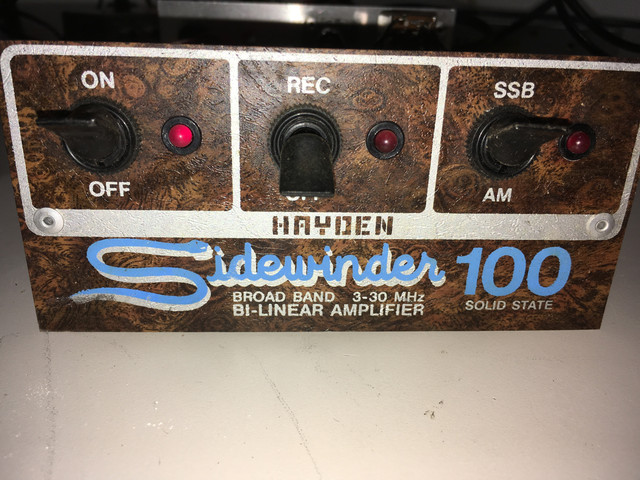
Hayden Sidewinder 100


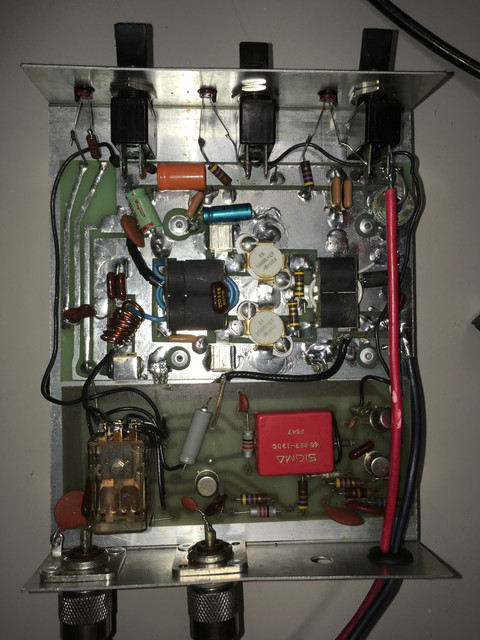
Rare indeed, that uses 4R7 (4.7 ohm) resistors not the typical 10 ohm.

454? Hmmm...Seems it wants to output into INDUCTANCE in series, not capacitance - which those caps, in above photo is parallel output.

Compared to this Datasheet for the SD1446...
upload_2021-1-5_9-18-12.png

Might be closer to an SD1446 - runs deep into Class C Grounded INDUCTIVE input and has a conjugate output that needs series Inductance.

So to help with the response, they swamp the input with 4.7 ohm instead. Not as inductive as you see in SD1446 datasheets - but it may explain why the output seems so high. It uses the conjugate it has, they tuned the output for, looks to be 30MHz like you'd find in a typical output network in an AM CB. Uses Single-stage L-filter design.
 
Last edited:
Thanks Andy, super interesting info. I always try to post up when I run across something different like this as inevitably someone else will have questions on another one in the future.

I did a google yesterday and very little came up for "568BLYCF" but I found this link - https://archive.org/stream/73-magazine-1980-01/01_January_1980_djvu.txt

When I searched the text on the page I found the text below which is why I mentioned 454.

MRF454/568BLYCF
17.10
150ma
30MHz
2/$ 1.00

I guess we can assume the transistors are from late 70's/early 80's which would match the wood grain on the face of the amp :)
 
  • Like
Reactions: Handy Andy
Thanks Andy, super interesting info. I always try to post up when I run across something different like this as inevitably someone else will have questions on another one in the future.

I did a google yesterday and very little came up for "568BLYCF" but I found this link - https://archive.org/stream/73-magazine-1980-01/01_January_1980_djvu.txt

When I searched the text on the page I found the text below which is why I mentioned 454.

MRF454/568BLYCF
17.10
150ma
30MHz
2/$ 1.00

I guess we can assume the transistors are from late 70's/early 80's which would match the wood grain on the face of
I don't know jack about that amp, but as far as looks, I think it's cool :cool:
 
  • Like
Reactions: Cabover Bob
To give you some idea of age, the relay has a date code on it from 1975. The fact that it is still working 45 years later, does say something about it.
 
  • Like
Reactions: Cabover Bob
To give you some idea of age, the relay has a date code on it from 1975. The fact that it is still working 45 years later, does say something about it.

Even crazier is that it was shipped to me in a small cardboard box the exact size of the amp with NO padding or packing material around it whatsoever. I was surprised there weren't 10 parts shaking around inside by the time I got it.
 
A friend had a Sidewinder 350 in 1979 and it was already a couple/few years old.
That thing boomed and we thought it was HUGE power for the mobile at the time..
 
  • Like
Reactions: Shadetree Mechanic
@Big Kahuna - did you realize that back in those days you used to send in a "Readers information card"?

Yes! You'd circle the "number" listed - in this case the ASCII conversion failed but those are CATALOG prices!

And to think we wanted to give out our name and address for the sake of those low prices and KEWL stuff.

A $1.00??? WOW! LOL!

I'm thinking that they kept the 454 and BCYF types in the same "realm" doesn't mean they meant it as swappable, just the same "bin" to lump them in.

Man! Those were the days!
 
  • Like
Reactions: DoctorAudio
Around 1980 I worked for Bob Bollinger, the engineer from Hayden that designed their Sidewinder amps. He had left Hayden and opened a new company, Soltronics Inc in Anaheim Ca. I was the tech there.
The amp in your picture certainly has the name Hayden and Sidewinder on it but it has Palomar TX100 circuit boards and chassis. That is the only one I have seen like it. Who knows how that came about. The faceplate certainly looks to be professionally done.
Yes Hayden did use 568BLY transistors.
At Soltronics I rebuilt quite a few Sidewinder 350s and installed 100 watt transistors (MRF421). I was never fond of the board design/layout but they worked fairly well.
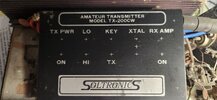
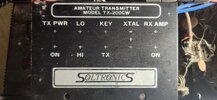
Bob/Soltronics made a few 4 transistor amps but not many, I still have a couple of them. I never liked the 568BLY transistors, very poor performers, prone to self oscillation and self destruction. IIRC they were spec'd as 80 watt devices. I always preferred Motorola and Toshiba and now HG. The Soltronics TX200CW did use those or CTC transistors but I changed them in mine. I'll post a couple pics since most people have never heard of this amp because of their limited production.
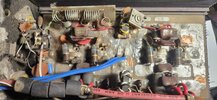
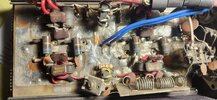
This Soltronics amp has been sitting on a shelf collecting dust in my warehouse for 40 years. It was used on an FM CB repeater (Pirate Radio Group) in So Cal for a while and battery acid somehow leaked on it. So it looks pretty crusty. The filter board in it is from a Palomar. I installed that on the input to clean the amp up for the repeater. It had a commercially made Low Pass filter on the output externally.
If you can see the circuit board under all the crud, it is very similar to the Sidewinder 350, just no driver transistor. These amps, TX200CW, had an oscillator and a crystal socket making them a "transmitter" which was the common ploy for amp builders at the time to avoid FCC raids.
After Soltronics closed down I built TX mobile amplifiers for a few years, until around 1986/87, TX200, 250, 300, 350, 400, 500, 600 and 800. Also some Silver Streak clones we called the DX180 and DX200, DX225.
I worked for Sundance Electronics as a tech prior to working for Bob at Soltronics. Sundance Electronics in Garden Grove Ca was the home of the Silver Streak amplifiers. Brian Godley did the engineering and board layout for the Silver Streak amps.
Sundance closed because of an FCC raid. Turned in by a dealer who refused to pay his bill...
Soltronics closed because of an Anaheim PD SWAT team raid, we were building pay TV - ON and Select TV decoders at night after the amp repair shop closed. The criminal charges were dropped later but the lawyers/legal problems put Bob (and his business partner Mark) out of business and me out of a great job with 2 great bosses.

 

Attachments

  • 20260117_213142.jpg
    20260117_213142.jpg
    818.6 KB · Views: 28
  • 20260117_213026.jpg
    20260117_213026.jpg
    998.7 KB · Views: 26
  • 20260117_221702.jpg
    20260117_221702.jpg
    1.4 MB · Views: 25
  • 20260117_221756.jpg
    20260117_221756.jpg
    1.4 MB · Views: 26
  • 20260117_221815.jpg
    20260117_221815.jpg
    1.3 MB · Views: 27
Last edited:
To give you some idea of age, the relay has a date code on it from 1975. The fact that it is still working 45 years later, does say something about it.
Potter and Brumfield made the best relays. Many amp builders used the R10 like in this photo. The R50 flatpack (the white square rec amp relay) were prone to failure because the contacts shifted when they were soldered into the board. The date on the relay doesn't really reveal the amp build date, just when the relay was manufactured and put into stock. Those R10 relays rarely ever go bad.
 

dxChat
Help Users
  • No one is chatting at the moment.
  • @ 357:
    holy man no activity or what?
  • dxBot:
    357 has left the room.
  • @ Hambones amps:
    Does anyone know if you can replace the 2290 in a galaxy dx 93t twin turbine with a 2sc2879 red dot? If so, what would have to be tuned?