• You can now help support WorldwideDX when you shop on Amazon at no additional cost to you! Simply follow this Shop on Amazon link first and a portion of any purchase is sent to WorldwideDX to help with site costs.
  • A Winner has been selected for the 2025 Radioddity Cyber Monday giveaway! Click Here to see who won!

Vertical Dipole CMC Question

Riverman

Sr. Member
I Support WorldwideDX.com!
Nov 12, 2013
3,063
3,422
273
I think this has been suggested in another thread, but I can’t find it, hence this post.

If one makes a vertical dipole out of copper pipe and runs the coax down the inside of the bottom piece, does doing so “decouple” it and prevent CMC? Also, is impedance adversely affected by not routing the coax away from the feedpoint at a 90 degree angle?
 
  • Like
Reactions: Crawdad

Have never tried that one but it's my belief that wouldn't de-couple, it would couple in a big way. Everything I've ever seen says run the coax away from feedpoint at a right angle, preferably for 1/4 wavelength minimum.

Removing CMC is easy and inexpensive:
20240831_193446.jpg

7 3
 
  • Like
Reactions: BC Coyote
If one makes a vertical dipole out of copper pipe and runs the coax down the inside of the bottom piece, does doing so “decouple” it and prevent CMC?
NO! Such an antenna might work, but probably not all that well. Ideally, the coax needs to run at right angles to the plane of polarization for at least 1/4 wavelength. If the coax needs to run straight down vertically you would need to have the lower element of the dipole become four horizontal ground plane elements instead of a single vertical.
Most dipole antennas whether vertical or horizontal will benefit from a simple coax balun at the feedpoint. That is the easiest way to minimize CMC's.
 
Am pretty sure I read a post where Captain Kilowatt said the copper pipe would provide decoupling if the coax were run inside it. Hopefully he will chime in here. The 90 degree rule is a headache for hanging a vertical dipole.
 
Am pretty sure I read a post where Captain Kilowatt said the copper pipe would provide decoupling if the coax were run inside it. Hopefully he will chime in here. The 90 degree rule is a headache for hanging a vertical dipole.
It is the headache for sure. Thought about an Inverted V? Work just fine for local and DX. Used them on 5 different bands with great results.

Or build the antenna like you want and see what happens.
 
Last edited:
Am pretty sure I read a post where Captain Kilowatt said the copper pipe would provide decoupling if the coax were run inside it. Hopefully he will chime in here. The 90 degree rule is a headache for hanging a vertical dipole.
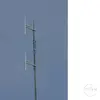
I work in FM broadcasting and when we use vertical dipoles they come as a stack, with each dipole stood off on a boom that is 1/4 wavelength long. I'm quite certain it's done that way for a good reason!
I've attached a picture.....Pro-FM-Broadcast-ProFM-BBDP3-Broadband-Dipole-Antenna-system-Aluminium-Stacked-array-of-2.webp
 
I clearly chose the wrong title for this thread. I am not concerned with CMC. My LDG 1:1 balun handles that. It is the routing of the coax I’m interested in. I know with a typical dipole, the coax has to be routed in a manner opposite the polarization. But does routing it inside a conductive leg negate that?
 
There you go! So build it and please share the results.
Please! Far too often people ask for advice, advice is given, and then we never find out the end result!

I'm thinking that the reason the design your asking about isn't common in the broadcast or two-way radio industries is likely to do with minimizing the effect of the tower structure the antenna(s) are mounted on.
The FCC, and ISEDC here in Canada require that broadcast and LMR stations have a known, fixed, antenna pattern, whether it is omni or otherwise, and having all antenna elements at least 1/4 wavelength from the mounting structure guarantees that the radiation pattern is not being affected by the tower itself.
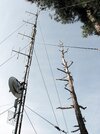
It would also be difficult to stack such a design. High powered commercial FM stations can have up to 8 or 12 antenna bays stacked one above the other. This makes a radiation pattern which is like a very squashed donut, with max power to the horizon and almost none anywhere else.
Antenna-tower-collinear-et-al.jpg
These are known as collinear arrays. Here is another pic....on this array the single elements have been stretched out into 3 element yagis, giving maximum gain in a single direction.
 
Have never seen this stated anywhere else. Waiting for CK to chime in. Or anyone else with knowledge of this.
Also wondering how impedance is affected.
 
Have never seen this stated anywhere else. Waiting for CK to chime in. Or anyone else with knowledge of this.
Also wondering how impedance is affected.

Am pretty sure I read a post where Captain Kilowatt said the copper pipe would provide decoupling if the coax were run inside it. Hopefully he will chime in here. The 90 degree rule is a headache for hanging a vertical dipole.

I did not look at the link to my original post but I will say that YES, running the coax inside the lower section will decouple the feedline IF THE BOTTOM SECTION IS CONNECTED TO THE OUTER SHIELD. They used to make a 1/2 vertical that was called a hypodermic style antenna where this exact same thing was done.

I work in FM broadcasting and when we use vertical dipoles they come as a stack, with each dipole stood off on a boom that is 1/4 wavelength long. I'm quite certain it's done that way for a good reason!
I've attached a picture.....View attachment 71685

Obviously they need to move the antennas away from the tower face. BTW, my condolences to your being in broadcasting. LOL I spent 22 years in myself servicing AM and FM sites, studios and many VHF/UHF program repeater sites.

Do you remember the Sinclair folded dipole antennas? That antenna brought the feedline into the end of the boom and up to the dipole mounting point which was grounded. The feedline ran inside the driven element to the opposite side which was open in the middle and connected to the feedline. This allowed feedline isolation as well as impedance matching.


Sinclair Folded Dipole
 
  • Like
Reactions: Crawdad

dxChat
Help Users
  • No one is chatting at the moment.