
• You can now help support WorldwideDX when you shop on Amazon at no additional cost to you! Simply follow this Shop on Amazon link first and a portion of any purchase is sent to WorldwideDX to help with site costs.
  • A Winner has been selected for the 2025 Radioddity Cyber Monday giveaway! Click Here to see who won!

On The Bench - Colt-890 Euro model...what a cool radio!!!

Lkaskel

Well-Known Member
I Support WorldwideDX.com!
Aug 4, 2017
521
433
73
61
Hey Everyone,

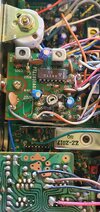
So, I have this Colt-890 from a local op on the bench to see if it can be resurrected. A few things here. I have never worked on a Colt radio before and have never even heard of an 890. This radio is from the late 70’s, still in the original box, has a Cybernet board in it (similar to the Telsat SSB 140) and has above and below 40 from the factory as well as FM. As you can see on the faceplate, the manufacturer must have used this radio for other purposes and just put stickers over some of the functions to change what they do as well as the radio label. I think its super cool!!! The radio has a clarifier that is open (receive only) and a Tune adjustment which adjusts transmit and receive frequency. The tune has a detent and is a course adjustment so it’s not very useful and the Clarifier is fine. It kind of reminds me of an early 80’s President Jackson import. This radio has a lot of factory mods and parts added to the main board. For instance, CT1 on the main board is replaced by a cap and CT2 does not have much of an effect on the alignment. The CT’s on the Band Board seemed to have the most effect.


I was able to get it working by cleaning the controls and switches and fixing the mic. In the end, the mic jack was a 4-pin so I rewired it to a Cobra 4-pin standard. I am still not 100% sure of the alignment as it has some boards in it I have never seen. I have fiddled with it and am able to get it on frequency enough for use but would love any thoughts.


Main Board – PTBM048A0X

Band Board – PT0S012A0X

FM Board – PTZZ050A0X


If anyone has any info on this radio please let me know.
 

Attachments

  • Like
Reactions: Tech5 and TM86

The PTBM048A0X board was used in a wide range of CB radios from various brands, including:

  • Colt: 480, 485DX, 890, 1000, 1200 (Excalibur)

  • Hy-Gain: 2705 (V), 2720, 2785, 3108 (VIII)

  • Lafayette:SSB80, SSB120, SSB140 (Telsat series)

  • Midland: 77-002, 78-976, 79-892

  • Cobra: Though often associated with Uniden, some "false" Cobra models like the Cobra 148 GTL-B actually used the Cybernet PTBM048A0X board.
  • Other brands: AWA/Thorn, Boman, Cardon, Gemtronics, J.C. Penny, JIL, Motorola, Palomar, Pearce-Simpson, RCA.
Hope this is of help I may be able to help more as I have worked on these way back when but it has been a while.
 

Attachments

  • Like
Reactions: Tech5
So this leads me to ask: What Year and some Brand/Models did the very first "Export" CB's with Factory Extra Channels appear? - I would not have thought it dipped into the late '70's but I'm not sure.
 
Fundamental theory of PLL circuit
The word PLL is an abbreciation of the "Phase Locked Loop" in which a given signal is processed to track the frequency and phase of a reference signal.
In other word, the PLL is of an automatic frequency control loop or automatic phase control.
The PLL circuit consists of the three units in simple form as shown:
ptbm048aoxfig_1.gif
In the above block diagram, when the reference frequency fr and the VCO output frequency fv to be compared are applied to the Phase Detector P/D, fv is compared with fr in terms of Phase lag and lead.
Then the resulting output (Phase difference) is converted in to the DC output voltage corresponding to the phase difference. Since the phase comparison is made at every cycle , the DC output may include unnecessary harmonics and noises . The DC output is , then, led to the low pass filter ( L.P.F) and integrated or smoothed to continuous DC voltage in proportion to the phase difference. The frequency of voltage controlled oscillator (V.C.O.) is controlled by the L.P.F. output voltage. Thus, controled VCO output is, then, split into two:
One used as an operating frequency of the unit and another will be returned to the plD, making a closed loop. The closed loop will con tinue to operate untill the following condition is met :
Ãr(t) = Ão(t)
This condition is called locked.
Employing the PLL system into a CB transciever requires some modifications so that the VCO generates specific frequency corresponding to each channel frequency [1 - 22 ] according to the channel selection. In the diagram below, a programmable divider, Mixer and Offset oscillator are newly added.
ptbm048aoxfig_2.gif
Q6 is the standard reference oscillator (lO.24OMHz) and Q5 is the buffer amp-lifier for the oscillator.
D6 is the diode through which DC voltage , which is supplied when the channel selector is placed between channels , is applied to the IC3 to disable the mixing operation inside the IC3. Thus no frequency will be generated though the channel selector is placed between correct channel positions.
For clearer understanding, please refer to the schematic diagram and the Block Diagram.
 
  • Like
Reactions: Shadetree Mechanic
AM/FM receiver circuit
A received signal passes T7 , then amplified in Q2O, and again passes the band pass filter consisting of T8 and T9, then, enters into the Mixer stage of Q22. On the other hand the first Rx local signal frequency is applied to the base of Q22 through a coupling capacitor of C14. Then, both signals are mixed with inside the Q22 and converted into the first IF signal (10.695MHz) in passing through the T10 and T13. The 10.695MHz signal and 10.240MHz signal generated in Q6 are applied to the balanced mixer consisting of D22 and D23 and 455kHz second IF frequency will be made .
This frequency is then led to the T14, CF (ceramic filter), Q27, Q28, Q29 (amplidied), T15 and finally led to the detector D25. The audio signal is then applied to the AF amplifier (IC5) through ANL CD26) circuit. The IC output drives the built-in speaker.
To improve signal over load distortion which would be caused when the receiver is subjected to a strong signal, three stages of AGC loops., each for Q20, Q22 and Q27, are provided.
Q21 is a switching transistor to short-circuit the primary circuit of T9 during transmit operation , thus disabling the receiver circuit.
While in FM receiving mode, the 455kHz signal amplified only through Q27 is led to FM demodulating IC, IC5O1 through T16. Resultant demodulated audio is acheived from the 1C pin #12 and input to AF gain control VR, VR1.

SSB receiver circuit
An incoming signal induced on the antenna is led to the T7 and applied to the then to Q20 and amplified. The amplified output is applied to the Q22 mixer through a bandpass filter consisting of T8 and T9. While the first local frequency is being applied to the base of the same transistor, both frequencies are mixed with each other and first IF frequency will be made (10.695MHz for AM/FM/USB , 10.692MHz for LSB) . This IF signal then amplified in passing through the T10, crystal filter, Q14, Tll, Q16 and Q17 and finally detected into the audio signalwith the product detector consisting of Q19. The audio signal is led to the Power IC (IC5) to drive the built-in speaker.
Q18 is the transistor to avoid undesirable impule noise , which will be generated in pressing the push-to-talk switch, from entering into the AGC circuit.
. To reduce the signal over load distortion in the SSB mode of operation, peak-value type AGC circuit consisting of Q3O, and Q31 is employed for exclusive use of SSB operation.


I JUST FOUND SOME MORE INFO IN MY FILES HERE IT IS.
 
AM/FM transmitter circuit
The first local oscillator frequency (37MHz band) and 10.695MHz frequency generated in the Q12 are led to the Pin #4 and Pin #1 of IC3, respectively, and mixed with each other, resulting in 27MHz band transmit frequency . The 27MHz output is led to the Q8, Q9, and Q10 through T4 and T5 in this order and amplified up to the high level necessary for transmission.
Thus amplified Power output is applied to the Antenna Connector through a bandpass filter consisting of L11, L12, L13, etc.
0n the other hand, the microphone input signal enters into the Power IC,(IC5, #6Pin terminal) and amplified output is applied to the collectors of Q9 and Q10 through the trans former T16 and diode D43 to modulate the transmit carrier frequency .
Transistor Q35 is the automatic level controller provided to suppress the audio input level to the IC5 properly to avoid the over modulation.
Q37 obtains its input signal from the audio output circuit through D43 and its output controls Q35, thus keeping modulation signal level to a relatively cons tant value.
In the FM mode, IC5 output is fed to the anode of the variable capacitor D4 in IC2 VC0 circuit, varying its bias to change VC0 signal phase component, finally giving deviation to PLL output frequency.

SSB transmitter circuit
In the mode of SSB operation, either of first local oscillator frequency of 37.660 - 37.920MHz (AM/FM/USB) or 37.657 - 37.917MHz (LSB) will be led to the IC #4Pin terminal. On the other hand the 10.695MHz (in LSB mode, this will be shifted to 10.692MHz as previously mentioned) generated with Q12 is led to the balanced modulation IC (IC4) . The 1C is designed to produce carrier-suppressed double side band signals when an audio signal amplified with IC5 is applied .to the PIN terminal of #1. Thus produced DSB signal will flow to Q13 and amplified , then led to the XF(crystal filter) to separate the desired side band.
The side band signal is led to the Q14 and be amplified, then led #3Pin terminal of IC3 and mixed with the output is led to the the first local signal to oscillator produce 27MHz transmit signal. The 27MHz SSB output is the led to the T4 and T5, then further led to the linear amplifiers, Q7, Q8, Q9 and Q10.
Thus amplified RF output is finally led to the antenna terminal through the Bandpass and low pass networks provided between the Q10 and antenna connector.
To avoid over modulation distortion , an ALC circuit consis ting of Q35 and Q38 is provided in the SSB microphone amplifier circuit. Another ALC circuit is also employed in the RF circuit (from Q10 to IF Amp Q14) to reduce the distortion in the RF stages.
Transistor Q36 and Q39 are switching circuits to operate IC5 as an SSB microphone amplifier.

Noise blanker circuit
An impulse signal included in the IF signals will be picked up through the capacitor C113 and positive-half voltage is then applied to the transistor Q24 and Q25 and amplified to enough level capable of turning the transistor Q26. The amplified impulse signal makes Q26 turn on while the impulse is being applied. In other word, the primary circuit of T10 is grounded to the chassis through C121 and the emitter- collector of Q26, so no mixer output will be obtained during this period. In this way the impulse noise will be blanked out.
D20 is the diode provided to control the bias voltage to the Q24 in according to the signal strength of the normal signals recieved, thus avoiding operation error which would caused by the normal signals.

Squelch circuit
When AGC voltage lowers with a weak recieved signal, transistors Q32 and Q33 turn on and this makes Q34 turn off, controlling the bias voltage to the AF AMP (IC 5) and disabling the amplifier. On the other hand when the transistor Q34 is turned on, the amplifier will start to operate.

Regulated power supply circuit
This circuit consists of Q44 and D50 and supplies voltage through the switching transistors Q40, Q41, Q43, depending upon the mode of operation.


Adjustment​

Test equipment required:
Power Supply: 13,8 VFrequency CounterDummy Load 50 ohmOscilloscope
DC AmperemeterRF SSGAF SSG

Preparation alignment:
ClarifierMid.
SQ GAINMax.
AF GAINMax.
RF GAINMax.
MIC GAINMax.
MOD, S/RFS/RF
NB/ANLOff
BandD
Channel19
StepAdjustIndicator Connectionremarks
PLL
1CT3Frequency Counter to TP2
AM-Modulation
10.240MHz
2CT1Oscilloscope and Frequency counter to TP3
AM-Modulation
20.105MHz
3CT2Frequency Counter to TP2
LSB-Modulation
20.1035MHz
4CT5Frequency Counter to TP5
AM-Modulation
10.695MHz
5CT4Frequency Counter to TP5
AM-Modulation
10.692MHz
VCO
6VCO-BlockVolt Meter to TP14,4Volt@Channel 19
RF Amplifier Bias Alignment
7RV1VoltMeter between Q10 Emitter and GND35mA
SSB Power Amplifier stage Alignment
Channel 11
8T1Oscilloscope and Watt Meter to Antenna jackFeed 2,4kHz to Microphone input. Adjust for maximum amplitude.
9T2Oscilloscope and Watt Meter to Antenna jackFeed 2,4kHz to Microphone input. Adjust for maximum amplitude.
SSB Power Amplifier stage Alignment
10T4Oscilloscope to base of Q8
Channel 22
Feed 2,4kHz to Microphone input. Adjust for maximum amplitude.
11T5Oscilloscope to base of Q8
Channel 1
Feed 2,4kHz to Microphone input. Adjust for maximum amplitude.
SSB Power Amplifier stage Alignment
Channel 11
12T6Oscilloscope to emitter of Q7Feed 2,4kHz to Microphone input. Adjust for maximum amplitude.
13T11Oscilloscope and Watt Meter to Antenna jackFeed 2,4kHz to Microphone input. Adjust for maximum amplitude.
14L7Oscilloscope and Watt Meter to Antenna jackAdjust for maximum
15L11Oscilloscope and Watt Meter to Antenna jackAdjust for maximum
16L13Oscilloscope and Watt Meter to Antenna jackAdjust for maximum
17RV4Oscilloscope and Watt Meter to Antenna jackAdjust for minimum Carrier lekage
18RV5Oscilloscope and Watt Meter to Antenna jackAdjust for minimum Carrier lekage
19RV11 (ALC)Oscilloscope and Watt Meter to Antenna jackFeed 500Hz and 2,4kHz to Microphone input. Adjust for 18 Watt.
AM Power Alignment
20RV1Oscilloscope and Watt Meter to Antenna jackAdjust for 12 Watt RF Power
Modulation Alignment
21RV12Oscilloscope and Watt Meter to Antenna jackAdjust for 80% AM-modulation
RF Power Meter Alignment
22RV3Watt Meter to Antenna jackAdjust RF Power Meter
Lock Out Circuit Check
23-VoltMeter between base of Q9 and GND0,05 - 0,4 Volt
Transmit Frequency Check
24-Frequency Counter to Antenna jackRead fequency on each channel (+/-900Hz)
RECEIVER
AGC Alignment
25RV8VoltMeter to Terminal 15 on PCB and GNDAdjust for 2 Volt
Receiver Sensitivity Alignment (AM-Mode)T78 ohm Dummy Load and Oscilloscope to external Speaker jackAdjust for maximum
26
Squelch Sircuit Alignment
27RV98 ohm Dummy Load and Oscilloscope to external Speaker jackAdjust so that the Audio output just appears on the Oscilloscope
28RV108 ohm Dummy Load and Oscilloscope to external Speaker jack
USB-Modulation
Adjust so that the Audio output just appears on the Oscilloscope
S-meter Alignment
29RV78 ohm Dummy Load and Oscilloscope to external Speaker jackSSB-Modulation. RF SSG and Ajust for "S" = "9"
30RV68 ohm Dummy Load and Oscilloscope to external Speaker jackAM-modulation. RF SSG and Ajust for "S" = "9"
FM Modulation Alignment
31RV501Connect Diviation Meter to Antenna jack.Adjust for 1,5kHz Modulation

Microphone Connection​

PinDescription
1Microphone
2Ground
3Speaker (Connect to Ground)
4TX Key (Connect to Ground)
 
Hey Everyone,

So, I have this Colt-890 from a local op on the bench to see if it can be resurrected. A few things here. I have never worked on a Colt radio before and have never even heard of an 890. This radio is from the late 70’s, still in the original box, has a Cybernet board in it (similar to the Telsat SSB 140) and has above and below 40 from the factory as well as FM. As you can see on the faceplate, the manufacturer must have used this radio for other purposes and just put stickers over some of the functions to change what they do as well as the radio label. I think its super cool!!! The radio has a clarifier that is open (receive only) and a Tune adjustment which adjusts transmit and receive frequency. The tune has a detent and is a course adjustment so it’s not very useful and the Clarifier is fine. It kind of reminds me of an early 80’s President Jackson import. This radio has a lot of factory mods and parts added to the main board. For instance, CT1 on the main board is replaced by a cap and CT2 does not have much of an effect on the alignment. The CT’s on the Band Board seemed to have the most effect.


I was able to get it working by cleaning the controls and switches and fixing the mic. In the end, the mic jack was a 4-pin so I rewired it to a Cobra 4-pin standard. I am still not 100% sure of the alignment as it has some boards in it I have never seen. I have fiddled with it and am able to get it on frequency enough for use but would love any thoughts.


Main Board – PTBM048A0X

Band Board – PT0S012A0X

FM Board – PTZZ050A0X


If anyone has any info on this radio please let me know.
OK BELOW IS ALL THE INFO I HAVE SORRY IT'S IN SEVERAL POSTS AS IT WAS TO LONG AND I DIDN'T HAVE TIME TO BREAK IT DOWN IN ONE FILE.
 
  • Like
Reactions: Tech5
Ok here is a Word doc. with all that mess in it sorry didn't know I had this I have about 1500 schematics on my new Computer system and still have not had time to look at it all.
 

Attachments

  • Like
Reactions: Tech5
Spent a little time hunting for anything on this radio, it appears to not have much out there. Although I now know where to go to find out how to rebuild a 78 Dodge Colt or a revolver.

What I was able to turn up was on this site, in this thread:

One of the links that promises info is dead, but the site is still live:
You just have to join that site to get at the data.

There is a schematic for the radio in the WWDX thread, so that may prove useful.
 
So this leads me to ask: What Year and some Brand/Models did the very first "Export" CB's with Factory Extra Channels appear? - I would not have thought it dipped into the late '70's but I'm not sure.
I had the same thought. It's so interesting that back then they just covered up labels on the faceplate with labels for the different features. While I would never pull those labels off I am curious to see what the original model was.
 
Spent a little time hunting for anything on this radio, it appears to not have much out there. Although I now know where to go to find out how to rebuild a 78 Dodge Colt or a revolver.

What I was able to turn up was on this site, in this thread:

One of the links that promises info is dead, but the site is still live:
You just have to join that site to get at the data.

There is a schematic for the radio in the WWDX thread, so that may prove useful.
Ok, so every once in a while someone replies to a thread with the best comment!!
..."Although I now know where to go to find out how to rebuild a 78 Dodge Colt or a revolver." had me laugh out loud.

Well done!!!!
 
Ok here is a Word doc. with all that mess in it sorry didn't know I had this I have about 1500 schematics on my new Computer system and still have not had time to look at it all.
Thanks so much for that document OldTech03!!
While it did address the radio overall it did not address the frequency alignment for the band board. I also used the alignment guide for the GE 3825A radio as a reference as it was almost the same. The fact that on the main board CT1 is missing and CT2 has little to no effect on the alignment was tricky. Here is what I did. Some of this may seem basic but I want to be sure that someone new to this can understand this as well. Please reference some of the items I shared at the begining of this thread to make sense out of things like the Band switch or the Band board. I started with the band switch in Mid (standard CB frequencies) and channel 19, Clarifier in the center and Tune in its detent. I checked the 10.240MHz at TP2. Of course, it was dead on. I then connected the freq counter to TP3 and tried to figure out what made the most sense. The alignment guide says to check AM/USB and adjust for 20.105MHz. I found that CT2 on the Band Board made this adjustment. I used my bench radio (Kenwood TS430) in TX and aligned CT2 for the best RX audio result in the Colt. I then switched the Colt and Kenwood into LSB and adjusted CT4 on the Band board for the best audio result. I then put the Colt in TX and adjusted CT5 and CT4 on the Main board for the best USB and LSB audio results on the Kenwood. I changed the mode switch to Hi. This is the 40 channels above the CB channels. CT3 on the Band board aligned this band. I changed the frequency on the Kenwood to 27.635MHz (CH19 of the Hi band) and used the TX of the Kenwood to align for the best audio results in the Colt. Finally, the mode switch to Low and CT1 of the Band board. I changed the Kenwood to 26.735MHz (CH19 of the Low band) and used the Kenwood TX to align for the best audio results in the Colt. One thing to note here, there is not a separate LSB offset for Hi and Low band RX or a TX offset either. It seems that you set them for the Mid band and they are what they are for the Hi and Low bands. I will say that when USB is aligned for Hi and Low bands LSB is just a little off. By a little, I mean 20Hz or so. You could use the Tune dial on the front panel as it adjust for both RX and TX but when you move it out of its detent it is over adjusted as the Tune control is a course adjustment. If there was a way to lock the clarifier as well that would solve the slight of freq issue as the Clarifier is a fine control. I did look at the clarifier lock procedures and R24 should be removed. Problem is, its already removed from the factory and a wire is installed from that to the Tune control. I did remove D5 but that did not work. All 3 terminals on the clarifier control are used so I am unsure what the best procedure for that is. The clarifier mode proceedure I referenced was:

Clarifier Unlock on PLL02A Chassis #PTBM048A0X (Lou Franklin's method)
1. Remove D5 and R24
2. Connect unused terminal of Clarifier control through 10-15k resistor to constant DC source at Emitter of Q44 regulator
3. Slide range increased by series coil in (+) leg of D3 varactor.
 

dxChat
Help Users
  • No one is chatting at the moment.