• You can now help support WorldwideDX when you shop on Amazon at no additional cost to you! Simply follow this Shop on Amazon link first and a portion of any purchase is sent to WorldwideDX to help with site costs.

Another 2517 low receive issue

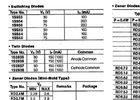
D16 and D17 should not be testing as zeners, those are regular switching diodes. At what voltage do they zener? The datasheet shows a reverse voltage rating of 30v.
1772068896278.png
 
I still do not have 8v on the RF gain control. Most I ever see on the RF gain control on this radio is 3.36v on any lead.

R233 shows 3.36v on one end and 0v on the other, when I turn the RF gain down then the control has no voltage on any lead. Shows as a 1k ohm (in circuit).

Replaced Q17 with a higher HFE of 82.
Replaced L5, can now see a little change when adjusting L5 but still not where it should be.

Checked R72 (I think it's R72) at D16/D17, shows as a 1k (in circuit).

Still lost
 
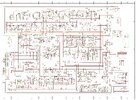
There will NEVER be 8v on the gain pot. The three components circled in green form a voltage divider. In RX, there should always be 8v on the left side of R233 and never more than 3.2v on the right side of it. That means there will never be more than 3.2v on the gain pot.
Dx2517sch2.jpg
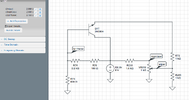
Here is a DC simulation with the pot maxed (counterclockwise). Here, it is putting the entire 1k in parallel with R291. The wiper and high side should both be at 2v.
1772078132229.png

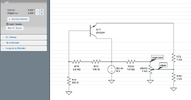
If we then swing the pot all the way down (fully clockwise in the radio), the wiper is at ground and the high side sees 3.2v
1772076661828.png

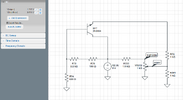
And if I set the pot half way, I get this (pointless adding these pics because the images are the same besides the voltages on the left, I know)
1772076698736.png

So now we have a voltage control between 0v and 2v on the wiper. Take a look at the bias resistors at Q17 (circled in blue in the schematic), they are another voltage divider. That divider puts 2.1v at the base. When the RF gain pot is turned all the way up (wired for MINIMUM wiper voltage), the base of Q17 has the most current through it. When the gain pot is turned down (increasing the wiper voltage), it will cause less voltage drop across R72 meaning there is less bias current and less gain.

For example, with no voltage at the wiper, the base voltage (2.1v) minus the Vbe drop puts 1.4v across the 1k resistor, so 1.4mA of bias. If the pot is set to half way, there is 2.1v-0.7v-1.2v= 0.2v across R72 (0.2mA of bias).

edited to make schematic pic smaller so it loads faster, my bad lol
 
Last edited:
  • Like
Reactions: Hawkeye351
I don't have 8v on either side of R233. I get 8v on the collector of Q17, but not on either end of R233. This is a different Q17, the old one had an HFE of 34, which I figured was too low, so I replaced it with another one with an HFE of 82.
 
I tried to touch up L5 but it does absolutely nothing for receive,
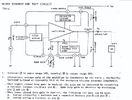
Unhook one end each of D16 and D17. See if L5 exhibits a peak now. L5 has no internal capacitor to go bad. If it won't show even a shallow peak there's a fault of some sort on its input side, most likely.

Or maybe the antenna was connected during a storm when a neighbor's tree was stuck? Burned insulation on L5 will reduce sensitivity, and turning the slug won't affect the signal level.

73
 
  • Like
Reactions: Hawkeye351
Unhook one end each of D16 and D17. See if L5 exhibits a peak now. L5 has no internal capacitor to go bad. If it won't show even a shallow peak there's a fault of some sort on its input side, most likely.

Or maybe the antenna was connected during a storm when a neighbor's tree was stuck? Burned insulation on L5 will reduce sensitivity, and turning the slug won't affect the signal level.

73
If an RF signal generator is available I'd inject a test signal right before the 1st mixer then work backwards towards the antenna connector.

If that inductor is bad, wouldn't be the first time for this symptom. L41 in the TS-530/830 series Kenwood hybrids and a couple of them used in the Tempo 2020 seem to be prone to burnout from excessive input signal.
 
  • Like
Reactions: Hawkeye351
do you have a way of checking how deaf the radio is?

Like, a signal generator with a calibrated output.

put a 1K tone into the radio at 30% modulation and see how far down it can hear.

you should be able to hear at least down to around -115dbm and im used to galaxy receivers still picking up a faint signal (like i can tell when i turn the RF output on and off) at -127dbm.

LC
 
  • Like
Reactions: Hawkeye351
Just got back on it today!

Signal generator shows great sensitivity.

Replaced:
IC8 TA7222AP
Replaced IC7 JRC4558
Q17
Q44
D16
D17
C80
C170
C172
C175
C179
C181
C182
C186
C187
C243

Receive volume still low in all modes, including PA mode with speaker plugged into PA jack. When I crank volume up to 3 o'clock I noticed strong signals sound slightly distorted

R232 tests as right at 1k ohm. Talkback switch knocks out receive completely when flipped on (switch on back).
Audio IC (IC8) still shows proper voltages on all leads.

Thinking maybe one of the poly caps.
 
I don't see C180 on that list, its a tantalum cap.

If you want to play with the gain, there are a couple ways to do it according to the datasheet. The RC between pins 6 and 9 increase negative feedback and reduce gain, so increasing R219 would increase the gain. Pins 5 and 6 provide access to the internal feedback path and lowering R220 will also increase gain. The datasheet says that shorting pin 5 to 6 leads to open loop gain (max gain), which makes sense because all of the signal that would provide negative feedback is shunted to ground via the cap at pin 5. See note 2.
1772849904199.png
 
  • Like
Reactions: Hawkeye351
Figured out the gain. Excel calc attached.
1772875152360.png
1772874661131.png
1772874694086.png
Reuploaded post, had to correct a typo in picture 2 and double check everything.

Edit: Been playing with the calculator for a bit now. I'd say if you mess with the series RC, change the cap, not the resistor. Smaller cap makes more gain. Going from 4.7nF to 1nF has about the same effect as going from 3.3k to 1Mohm. Both provide a little under 4dB change.
 

Attachments

Last edited:
  • Like
Reactions: Hawkeye351
"I don't see C180 on that list, its a tantalum cap." , Brandon I see C180 location but there's nothing there. The schematic shows a tant at C180, the parts layout shows a tant at C180 but the cap list skips from C179 to C181 and doesn't list C180. Just a silkscreen marking for C180 but no tant there.
 
Odd thing is, after I replaced the 7222 IC, then the volume came up slightly but transmit audio dropped out completely (still a carrier, but not modulation now) and the added talkback switch shuts receive down completely when flipped on (didn't do that before swapping out IC8). I figured the swap may have shorted out the mic amp (4558) is why I replaced it too, but didn't bring modulation back. Checked over all my work under the magnifying glass and I see no solder blobs, solder balls, shorts, everything looks good.

Maybe this 7222 I pulled from another radio is bad. Also, if I'm not mistaken, the marking on the IC (7222) should face the chassis when mounting (as I did).

Serial number on the back, if I'm reading it correctly seems to indicate a 2003 model, so I've just started recapping the whole radio.
 

dxChat
Help Users
  • No one is chatting at the moment.
  • @ heartbreaker3473:
    Hello gentlemen and Ladies. I have the dreaded RCI-2990 receive issue where my radio gets distorted when people get close to my location. I found the C90 Capacitor, but I can not for the life of me find the C89 capacitor. Can or does anyone have a picture of the exact location of C89 ? Thank you in advance, Wes
  • @ AudioShockwav:
    Wes, it's better if you start a thread on the main forum, more people are going to see your question.
  • @ heartbreaker3473:
    Okay, sorry, will put in a forum
  • @ heartbreaker3473:
    I put it in the general disscution help area and started a new thread. Thank you for letting me know.