• You can now help support WorldwideDX when you shop on Amazon at no additional cost to you! Simply follow this Shop on Amazon link first and a portion of any purchase is sent to WorldwideDX to help with site costs.

Galaxy DX2517 Troubleshooting Help

Q37 is the voltage regulator that provides a steady 9 Volts to the transmit/receive switching circuits. If it fluctuates like that, stuff gets twitchy.

I became impatient with fixing this regulator circuit. You pretty much have to take Q35, D72 and D73 each loose to test them. We adopted the policy of using a 7808T TO-220 3-terminal regulator to replace it. We add a 1N4001 diode between the chip's ground (center) pin and circuit-board ground.
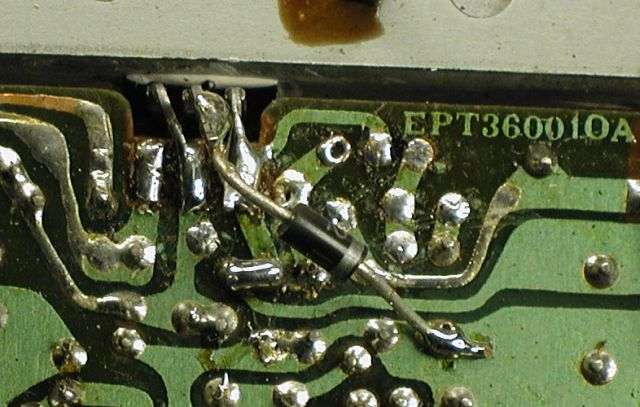
ept360010a9vregsubsm.jpg


The chip's center pin is in fact connected ONLY to the diode, not to the circuit board directly. The pic doesn't offer a clear perspective view of this.

The diode boosts the output of the 8-Volt chip close to 9 Volts. And if you can find a 7809T that's simpler. No diode required.

This radio probably won't behave itself until it has a steady source of regulated 9 Volts.

73
 
  • Like
Reactions: Dr. Frankenstein
Q37 is the voltage regulator that provides a steady 9 Volts to the transmit/receive switching circuits. If it fluctuates like that, stuff gets twitchy.

I became impatient with fixing this regulator circuit. You pretty much have to take Q35, D72 and D73 each loose to test them. We adopted the policy of using a 7808T TO-220 3-terminal regulator to replace it. We add a 1N4001 diode between the chip's ground (center) pin and circuit-board ground.

ept360010a9vregsubsm.jpg


The chip's center pin is in fact connected ONLY to the diode, not to the circuit board directly. The pic doesn't offer a clear perspective view of this.

The diode boosts the output of the 8-Volt chip close to 9 Volts. And if you can find a 7809T that's simpler. No diode required.

This radio probably won't behave itself until it has a steady source of regulated 9 Volts.

73
Okay i ordered the 7808’s from Amazon and will be here tomorrow. While I’m waiting today I might try that modification on the photo you provided with the stock regulator and diode to see if it works and get back with you later. Also, d72 and d59 have been replaced with 3 series 1n4148’s. Is that acceptable or could that cause a problem? And I have already replaced d73, and q35 with a 2sc1815 which according to the internet is a modern substitute for the original sc945.
 
Last edited:
Okay i ordered the 7808’s from Amazon and will be here tomorrow. While I’m waiting today I might try that modification on the photo you provided with the stock regulator and diode to see if it works and get back with you later. Also, d72 and d59 have been replaced with 3 series 1n4148’s. Is that acceptable or could that cause a problem? And I have already replaced d73, and q35 with a 2sc1815 which according to the internet is a modern substitute for the original sc945.
It's always somethin, there was a solder trace that was loose from the board near q35 and decided to stop and repair it but when I turned it on I saw a little orange arc jump between two adjacent traces near the q30-q33 area I think from the voltage rail to ground and then lost power to the radio and the lights went out. I switched from crc to 91% alcohol and a tooth brush to clean where the arc was in case it was a carbon track or flux causing it. After cleaning that area I checked D110 and is good and d109 reads shorted but when I lift one end the diode tests good and there is still a short on the traces. is it possible that the t1 transformer could be shorted from the arc since it is also across the 2 traces that are reading shorted at d109? I appreciate the help and happy Easter!
 
It's always somethin, there was a solder trace that was loose from the board near q35 and decided to stop and repair it but when I turned it on I saw a little orange arc jump between two adjacent traces near the q30-q33 area I think from the voltage rail to ground and then lost power to the radio and the lights went out. I switched from crc to 91% alcohol and a tooth brush to clean where the arc was in case it was a carbon track or flux causing it. After cleaning that area I checked D110 and is good and d109 reads shorted but when I lift one end the diode tests good and there is still a short on the traces. is it possible that the t1 transformer could be shorted from the arc since it is also across the 2 traces that are reading shorted at d109? I appreciate the help and happy Easter!
Happy Easter!

A loose trace may been the cause of the fluctuation. T1 is a choke, not a transformer, and it is in parallel with D109 so the short you read when D109 is in circuit is normal. If we knew exactly where the arc happened, that would help.

We need to check voltages around Q37 again to see if that took the regulator out (after you repair any loose traces).
 
Happy Easter!

A loose trace may been the cause of the fluctuation. T1 is a choke, not a transformer, and it is in parallel with D109 so the short you read when D109 is in circuit is normal. If we knew exactly where the arc happened, that would help.

We need to check voltages around Q37 again to see if that took the regulator out (after you repair any loose traces).
IMG_9958.jpeg
Between the end of jp81 and the end of the other short jumper next to it where the 2 red lines are drawn. With a pick it feels like it actually started to burn a small pinhole into the board between the traces but not all the way through. After it happened I noticed it was a little dirty around those traces from flux maybe so I cleaned it well with alcohol and a toothbrush and looks a lot cleaner. But now when I turn it on the power supply sees no current and the face of the radio went out.
 
So a short between the output of choke T1 and ground. The choke and the diode already checked out, so It probably blew the fuse or regulator on the power supply. Check the fuse first.
 

dxChat
Help Users
  • No one is chatting at the moment.