• You can now help support WorldwideDX when you shop on Amazon at no additional cost to you! Simply follow this Shop on Amazon link first and a portion of any purchase is sent to WorldwideDX to help with site costs.

Cobra 135 XLR with DDS installed with TX/RX issue HELP needed

Retro CB Guy

Well-Known Member
Jun 22, 2014
806
275
73
Hi CB folks, Been a minute since I posted much but I sure could use some help and I know there are alot of smart minds with experience out
there!

So this Cobra 135XLR is in great shape not messed with too much and has a DDS of the latest firmware from Troy Radio in Texas installed by an
experienced retired tech. Everything installed correctly, and radio worked flawslessly prior to install of DDS. The issue is VERY wimpy RX and same
for TX... Sooooooooooooooo, exploring options and ideas and I hope there is some folks in the know that could share some knowledge with what
to look for, and where to look for etc etc...

Doubled sided board isn't exactly anybodys cup of tea to work I guess but it is what it is!

Thanks in advance as I'd really love to get this thing on track ASAP, Retro
 

If it worked until the DDS was installed then it would probably be a good idea to make sure the DDS is up to snuff as far as output signal goes.

I don't know what the output signal on of those looks like so I'll just say it should look as much like what a stock radio would generate as possible. IE, sine wave at about the same p-p level as stock.

Other than that, poke around with a scope probe and see if you can find where the signal drops off to cause the weak performance and look out for solder blobs, cold solder joints, and hairline cracked solder joints. It's usually the simple stuff that's the biggest headache.
 
  • Like
Reactions: Retro CB Guy
Down the Alice In Wonderland rabbit hole. This Cobra 135XLR had a Troy Radio DDS installed. Looked okay to me. The tech who did the job reported "It wouldn't receive. Pressed on the main circuit board and it sprung to life, wouldn't shut down again after that." Or something to that effect.

It arrived deaf and mute. No transmit, except for what leaked out of the transmit mixer into another radio on the bench. And very weak receive. A fault shared by transmit and receive should be caused by some function that's shared, right?.

The incredibly weak receive seemed baffling. The output of the 5351 DDS chip was connected to TP311, the output of the VCO buffer transistor. I reasoned that insufficient drive level from that point to the two mixer circuits would hold back receive and transmit signals. And then I discovered that the factory VCO circuits were still running. Yeah, two VCOs. One for AM and LSB, the other one for USB. Removing C305 and C307 took them out of the picture. Two local-oscillator signals together made the 'scope trace at TP311 way too fuzzy. I moved the output of the DDS to the gate of Q303, where the original VCOs fed into. Figured it would improve the level at TP311. Receiver is still weak, and still no transmit.

Got flustered and rechecked alignment. For those playing along with the home version, the schemo is attached. It required a few hundred microVolts to hear anything at all. The alignment tuning slugs upstream from the IF crystal filter all showed normal peaks. The next one downstream following the crystal filter is T5. Turn the slug, no response. Doesn't change signal level. This points to trouble in the circuit attached to T5. The transistor that drives into T5 is Q4. DC voltages on Q4 are all wrong. Base and emitter voltages are way high. Collector voltage is way low, barely higher than the emitter voltage. As if it were shorted C-E. Pulled Q4, but it's not shorted. Checks perfect. The base voltage with Q4 removed is still way high. Long story short, the PLL-unlock lockout is active. That circuit is required for the radio's design to be FCC-legal. Rule says it has to shut down the transmitter if the PLL loses control of the radio's frequency. Prevents transmitting outside channels 1-40. Some radios also shut down the receiver as well. This one does. Well, this radio's PLL has four (count 'em) four chips. Soon after this model arrived on the market, single-chip PLL circuits became common. This radio was only a little ahead of its time. Turns out that the PLL unlock-protect circuit is active. The main PLL chip was removed, just like for any other Troy Radio DDS install. But the out-of-lock signal doesn't come from that chip. It comes from two of the other three PLL chips. Turns out the best fix to disable the out-of-lock-disable feature is to cut one foil trace where the two unlock signals come together. It's the collector of a PNP switch transistor Q22. In the factory schemo, it's directly above the symbol for the mike's pickup element, near the bottom of the diagram. This view is with the front of the radio facing you.
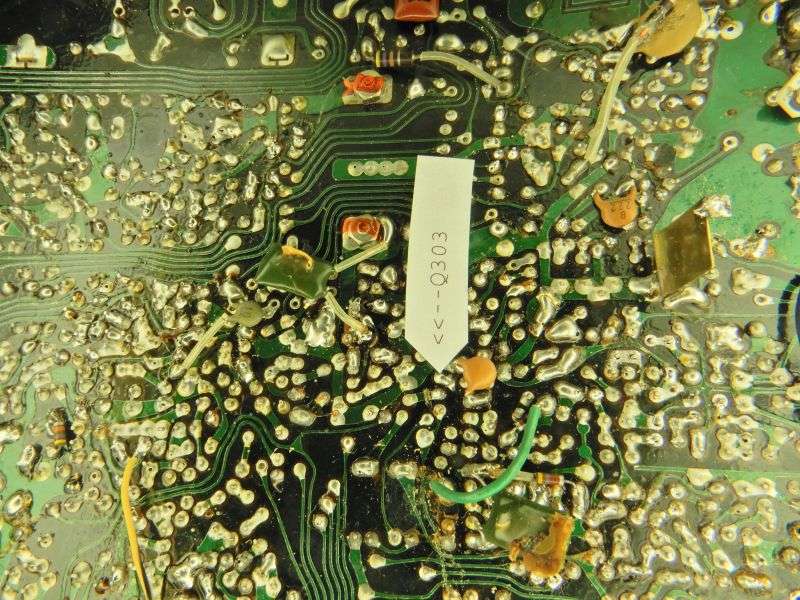
f5F7dF.jpg


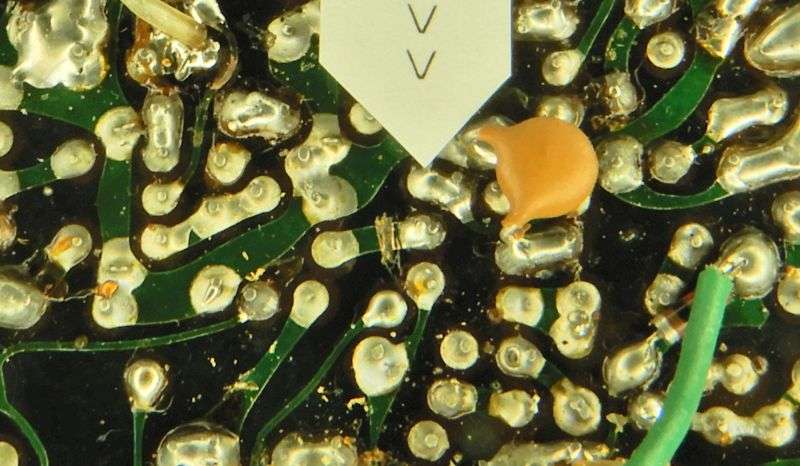
A closer view of the collector trace.

dJMYtD.jpg


I cut the trace with the power on. As soon as it was severed, the receiver roared to life. Previously had to turn the volume full up to hear much at all. Turns out now it transmits, too.

Wahoo!

I know a fella up in Chicago who thinks the 23-channel 135 sounds better with a DDS than this version.

I have no way to know, but this radio proves to be more broad banded than I expected. Good thing I'm not prone to tearing out my hair. Disabling this function is easy for a single-chip PLL, just find that foil pad when the PLL chip is removed and jumper it either to ground or to the chip's power pin, whichever logic state a properly-locked chip would produce on that pin.

Sure won't miss this detail again.

Poor choices come from lack of experience.

Experience comes from making poor choices.

73

 

Attachments

Down the Alice In Wonderland rabbit hole. This Cobra 135XLR had a Troy Radio DDS installed. Looked okay to me. The tech who did the job reported "It wouldn't receive. Pressed on the main circuit board and it sprung to life, wouldn't shut down again after that." Or something to that effect.

It arrived deaf and mute. No transmit, except for what leaked out of the transmit mixer into another radio on the bench. And very weak receive. A fault shared by transmit and receive should be caused by some function that's shared, right?.

The incredibly weak receive seemed baffling. The output of the 5351 DDS chip was connected to TP311, the output of the VCO buffer transistor. I reasoned that insufficient drive level from that point to the two mixer circuits would hold back receive and transmit signals. And then I discovered that the factory VCO circuits were still running. Yeah, two VCOs. One for AM and LSB, the other one for USB. Removing C305 and C307 took them out of the picture. Two local-oscillator signals together made the 'scope trace at TP311 way too fuzzy. I moved the output of the DDS to the gate of Q303, where the original VCOs fed into. Figured it would improve the level at TP311. Receiver is still weak, and still no transmit.

Got flustered and rechecked alignment. For those playing along with the home version, the schemo is attached. It required a few hundred microVolts to hear anything at all. The alignment tuning slugs upstream from the IF crystal filter all showed normal peaks. The next one downstream following the crystal filter is T5. Turn the slug, no response. Doesn't change signal level. This points to trouble in the circuit attached to T5. The transistor that drives into T5 is Q4. DC voltages on Q4 are all wrong. Base and emitter voltages are way high. Collector voltage is way low, barely higher than the emitter voltage. As if it were shorted C-E. Pulled Q4, but it's not shorted. Checks perfect. The base voltage with Q4 removed is still way high. Long story short, the PLL-unlock lockout is active. That circuit is required for the radio's design to be FCC-legal. Rule says it has to shut down the transmitter if the PLL loses control of the radio's frequency. Prevents transmitting outside channels 1-40. Some radios also shut down the receiver as well. This one does. Well, this radio's PLL has four (count 'em) four chips. Soon after this model arrived on the market, single-chip PLL circuits became common. This radio was only a little ahead of its time. Turns out that the PLL unlock-protect circuit is active. The main PLL chip was removed, just like for any other Troy Radio DDS install. But the out-of-lock signal doesn't come from that chip. It comes from two of the other three PLL chips. Turns out the best fix to disable the out-of-lock-disable feature is to cut one foil trace where the two unlock signals come together. It's the collector of a PNP switch transistor Q22. In the factory schemo, it's directly above the symbol for the mike's pickup element, near the bottom of the diagram. This view is with the front of the radio facing you.

f5F7dF.jpg


A closer view of the collector trace.

dJMYtD.jpg


I cut the trace with the power on. As soon as it was severed, the receiver roared to life. Previously had to turn the volume full up to hear much at all. Turns out now it transmits, too.

Wahoo!

I know a fella up in Chicago who thinks the 23-channel 135 sounds better with a DDS than this version.

I have no way to know, but this radio proves to be more broad banded than I expected. Good thing I'm not prone to tearing out my hair. Disabling this function is easy for a single-chip PLL, just find that foil pad when the PLL chip is removed and jumper it either to ground or to the chip's power pin, whichever logic state a properly-locked chip would produce on that pin.

Sure won't miss this detail again.

Poor choices come from lack of experience.

Experience comes from making poor choices.

73
Sure appriciate the help Chris, and quite an interesting road to the solution for sure !!! This one is a keeper and I'm honored to have been present while this all went down with you sir...

Also thanks for the input above from the other folks.

Awesomeness, and thanks for this forum !

73's Retro
 
  • Like
Reactions: Shadetree Mechanic
Well I am the fella that did the original install and I followed what instructions I had to a T but Troy Driscoll did one on a 132xlr and is basically the same radio so thats what I went with,I suspected there may have been a production change in the original design at some point because the 132 he expanded with the dds kit worked great.Yes it is true I could poke around the original pll location and it would for whatever reason come to life for a second then faided into the sunset,Anyhow I am glad you figured it out i just knew it was beyond my capabilities to find the issue so I quit before I destroyed the radio..Thanks for the explanation of the repair.
 

dxChat
Help Users
  • No one is chatting at the moment.
  • @ Hambones amps:
    Does anyone know if you can replace the 2290 in a galaxy dx 93t twin turbine with a 2sc2879 red dot? If so, what would have to be tuned?
  • @ ShadowDelaware:
    Hambones the entire amp section would have to be retuned, and the rf transformers re wrapped.