
You are using an out of date browser. It may not display this or other websites correctly.
You should upgrade or use an alternative browser.
You should upgrade or use an alternative browser.
-
You can now help support WorldwideDX when you shop on Amazon at no additional cost to you! Simply follow this Shop on Amazon link first and a portion of any purchase is sent to WorldwideDX to help with site costs.
-
The Winners of the three Retevis radios 16 Anniversary giveaway are announced!! Click Here to find out if you won!
Vintage Realistic CB Base Radio
- Thread starter Recon
- Start date


Actually, a ham receiver that's on frequency and a phone app that emits a 1 kHz tone can be used for this. The more accurate the receiver's frequency the more accurate your result will be. You'll need to use a coax jumper cable with the connector shell threaded back over the plug to expose the center pin. That pin becomes a half-inch long 'sniffing' antenna to pick up internal frequencies inside the 457.
Tune in the carrier oscillators with the radio on LSB and set 1 KHz above the crystal frequency. Tune the carrier crystal's trimmer cap so that a 1 kHz tone from the receiver speaker 'beats' with the tone from the phone app. Not so different from tuning a guitar with a tuning fork.
With the ham radio on a dummy load, key it with the phone's 1 kHz tone into the mike. Set the PLL trimmer for each mode so what comes out the TRC457 speaker matches the pitch of the phone's tone pitch.
Same goes for the 457's transmit frequency. Tone into the 457's mike, set the trimmer so what comes out the receiver's speaker lines up with the phone's pitch.
Naturally this is an oversimplified description of the process, but an accurate source of a 1 kHz tone and another radio that's accurately on frequency can take the place of fancy bench instruments.
73
Tune in the carrier oscillators with the radio on LSB and set 1 KHz above the crystal frequency. Tune the carrier crystal's trimmer cap so that a 1 kHz tone from the receiver speaker 'beats' with the tone from the phone app. Not so different from tuning a guitar with a tuning fork.
With the ham radio on a dummy load, key it with the phone's 1 kHz tone into the mike. Set the PLL trimmer for each mode so what comes out the TRC457 speaker matches the pitch of the phone's tone pitch.
Same goes for the 457's transmit frequency. Tone into the 457's mike, set the trimmer so what comes out the receiver's speaker lines up with the phone's pitch.
Naturally this is an oversimplified description of the process, but an accurate source of a 1 kHz tone and another radio that's accurately on frequency can take the place of fancy bench instruments.
73
Wow! Thank you, but unfortunately this is way out of our pay grade. My friend and only local person I associate with on the radio lives about twenty-miles from my location. We will probably need to locate a reputable radio repair shop to have the radio aligned. I'm assuming that there are no simple internal adjustments that he could adjust and I can use my Stryker 955 or AnyTone 5555 Plus to help him. We were able to (sort of) get his Galaxy 2547 on frequency.Actually, a ham receiver that's on frequency and a phone app that emits a 1 kHz tone can be used for this. The more accurate the receiver's frequency the more accurate your result will be. You'll need to use a coax jumper cable with the connector shell threaded back over the plug to expose the center pin. That pin becomes a half-inch long 'sniffing' antenna to pick up internal frequencies inside the 457.
Tune in the carrier oscillators with the radio on LSB and set 1 KHz above the crystal frequency. Tune the carrier crystal's trimmer cap so that a 1 kHz tone from the receiver speaker 'beats' with the tone from the phone app. Not so different from tuning a guitar with a tuning fork.
With the ham radio on a dummy load, key it with the phone's 1 kHz tone into the mike. Set the PLL trimmer for each mode so what comes out the TRC457 speaker matches the pitch of the phone's tone pitch.
Same goes for the 457's transmit frequency. Tone into the 457's mike, set the trimmer so what comes out the receiver's speaker lines up with the phone's pitch.
Naturally this is an oversimplified description of the process, but an accurate source of a 1 kHz tone and another radio that's accurately on frequency can take the place of fancy bench instruments.
73

As my long departed Dad would have said.... "Do it properly or not at all"We were able to (sort of) get his Galaxy 2547 on frequency.
The band has plenty of off frequency radios already; "sort of" isn't good enough.
Find a qualified tech and have that radio aligned properly.
That 457 is a fantastic radio by the way! I have three dead ones here that I dream of one day bringing back to life (if I ever have the time LOL!).

For that radio to perform its best, the alignment will be far more effective if the clarifier is modified to control both the transmit (TX) and receive (RX) frequencies simultaneously. In other words, when you adjust the clarifier, it should shift both frequencies together to keep them in sync.
Even after a perfect alignment, if the clarifier only adjusts your receive frequency, you will inevitably find that other operators report you are slightly off-frequency during transmission. The solution is to have the clarifier reworked first, and then perform the alignment.
I have performed this modification on thousands of these radios over the last 50 years, and I've never had a customer who wasn't pleased with the result. Find a technician with good reviews to do the work, and you will be very happy with the outcome.
Even after a perfect alignment, if the clarifier only adjusts your receive frequency, you will inevitably find that other operators report you are slightly off-frequency during transmission. The solution is to have the clarifier reworked first, and then perform the alignment.
I have performed this modification on thousands of these radios over the last 50 years, and I've never had a customer who wasn't pleased with the result. Find a technician with good reviews to do the work, and you will be very happy with the outcome.
The conversion to "lock" the clarifier's receive frequency to the transmit frequency is pretty simple on that radio. One diode gets removed. One resistor gets pulled from the top side of the circuit board and lap-soldered across two foil traces on the solder side.
This has the advantage that when you tune in a station, he'll hear you on the exact same frequency.
Got pics here somewhere..
73
This has the advantage that when you tune in a station, he'll hear you on the exact same frequency.
Got pics here somewhere..
73
Found it! Image Shack has lost a lot of our old pics over the years. Not quite sure how they do that. But here they are.
First step is to remove D30 and R119.
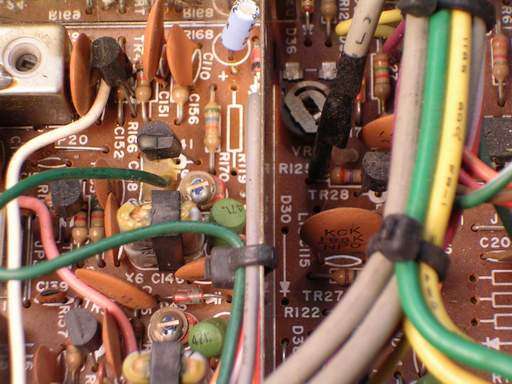
R119 gets soldered to the foil traces seen here. First, a wide view to show where the closeup detail is found.
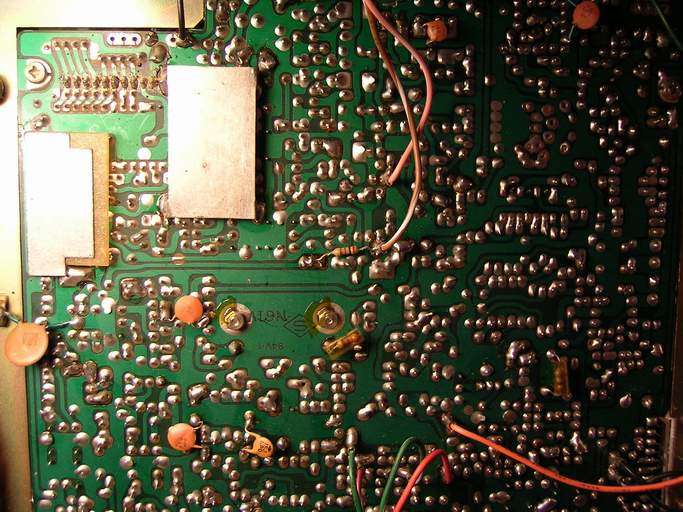
And a close view showing detail.
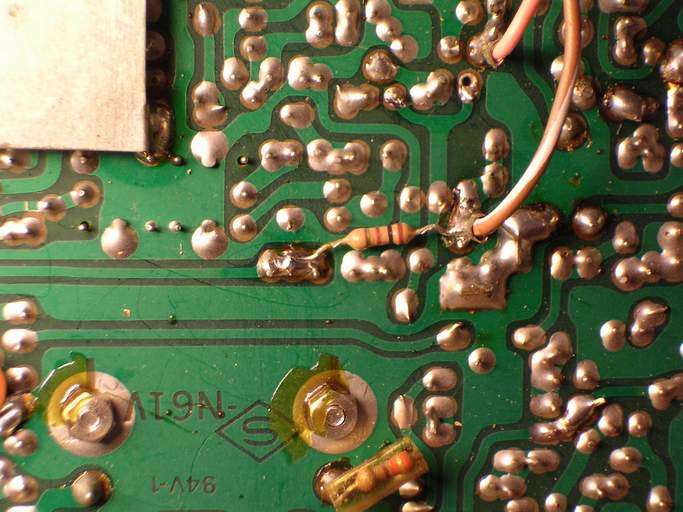
About as simple as it gets to lock the clarifier to transmit and receive.
73
First step is to remove D30 and R119.
R119 gets soldered to the foil traces seen here. First, a wide view to show where the closeup detail is found.
And a close view showing detail.
About as simple as it gets to lock the clarifier to transmit and receive.
73
I'm not a fan of unlocked clarifiers. When a station is off frequency, I would rather tell him (or her) so and have him clarify on my transmit signal. To get the transmit signal on the 858SSb chassis (TRC457) spot on freq, first sub in a 10-turn pc pot for VR9. This allows a very fine adjustment of the transmit frequency and will put your rig on freq all the time.
- J.J. 399
- J.J. 399
There seems to be different use of terminology on different posts but you are ok with Receive and Transmit frequency moving together at the same time. Just clarifying some call modifying the clarifier for equal tracking of REC & XMIT Frequency unlocked and some call it locked. Just making sure I'm on the same page with everyone.I'm not a fan of unlocked clarifiers. When a station is off frequency, I would rather tell him (or her) so and have him clarify on my transmit signal. To get the transmit signal on the 858SSb chassis (TRC457) spot on freq, first sub in a 10-turn pc pot for VR9. This allows a very fine adjustment of the transmit frequency and will put your rig on freq all the time.
- J.J. 399

Thanks for sharing this. I have been adverse to doing the "unlock" process on this chassis due to all the ambiguous information and desired results posted over the years. The simplicity of this solution I like!Found it! Image Shack has lost a lot of our old pics over the years. Not quite sure how they do that. But here they are. First step is to remove D30 and R119 ... R119 gets soldered to the foil traces seen here. About as simple as it gets to lock the clarifier to transmit and receive.
Just too used to the ham bands. Everybody lines up their transmit frequencies together. You use your RIT for the schmucks who can't quite get there. A 2-party conversation works just fine with factory-locked transmit frequency. You tune each other in and all is good until that third person comes on the channel and asks why you two guys are talking on two different frequencies.
A 23-channel CB clarifier was "locked" to both transmit and receiver frequency until around 1974. The FCC decided too many people were modifying that feature to transmit outside the plus/minus 1.3 kHz legal limit of .005 percent. Service data for radios from that era will have the additional parts to make the clarifier receive-only marked in dotted lines, since the changes were made while those models were in production. Other rules that got tightened in that round now required a modulation limiter for AM and ALC to limit sideband peaks to 12 Watts. Until then, those were optional.
It's all in how you want to operate, after all.
73
A 23-channel CB clarifier was "locked" to both transmit and receiver frequency until around 1974. The FCC decided too many people were modifying that feature to transmit outside the plus/minus 1.3 kHz legal limit of .005 percent. Service data for radios from that era will have the additional parts to make the clarifier receive-only marked in dotted lines, since the changes were made while those models were in production. Other rules that got tightened in that round now required a modulation limiter for AM and ALC to limit sideband peaks to 12 Watts. Until then, those were optional.
It's all in how you want to operate, after all.
73

Nomad, thanks for two things.......Just too used to the ham bands. Everybody lines up their transmit frequencies together. You use your RIT for the schmucks who can't quite get there. A 2-party conversation works just fine with factory-locked transmit frequency. You tune each other in and all is good until that third person comes on the channel and asks why you two guys are talking on two different frequencies.
A 23-channel CB clarifier was "locked" to both transmit and receiver frequency until around 1974. The FCC decided too many people were modifying that feature to transmit outside the plus/minus 1.3 kHz legal limit of .005 percent. Service data for radios from that era will have the additional parts to make the clarifier receive-only marked in dotted lines, since the changes were made while those models were in production. Other rules that got tightened in that round now required a modulation limiter for AM and ALC to limit sideband peaks to 12 Watts. Until then, those were optional.
It's all in how you want to operate, after all.
73
The process on the TRC-457 chassis.... and
Finally getting through my skull with a purpose for RIT.
I had never thought about using it that way.
I hope the OP of this thread doesn't mind the side tracks that have been taken but here's another; expanding out on the view that Nomad has provided on the oscillator section with D30 and R119, I noticed just to the right is a small foot print where components are silk screened but not installed. Components used by another manufacturer for another radio? Anyone have some insight on this?
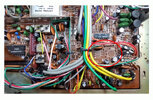
I have never tried to trace out what those parts would do. Was it a feature left out? Or a feature that didn't work out as intended? Somebody ought to draw up what those missing parts connect to. Sometimes my lack of curiosity can be apalling.
73
73
dxChat
- No one is chatting at the moment.