Or transformer I really meanProbably but hopefully not in my PS

You are using an out of date browser. It may not display this or other websites correctly.
You should upgrade or use an alternative browser.
You should upgrade or use an alternative browser.
-
You can now help support WorldwideDX when you shop on Amazon at no additional cost to you! Simply follow this Shop on Amazon link first and a portion of any purchase is sent to WorldwideDX to help with site costs.
-
The Winners of the three Retevis radios 16 Anniversary giveaway are announced!! Click Here to find out if you won!
Wawasee JB-2000 issues
- Thread starter Danzik
- Start date
no telling how your amp is different than that schematic,
and the amp here in town that I worked on.
(I never want to work on it again!)
but off of the negative side of the HV capacitor board,
a 10 ohm 10W going to ground. It acts as a little "cushion"
when powering up, and also can blow as a fuse.
any resistor around that value will work.
or is not needed.
but if your negative side goes directly to ground,
then maybe you have a burned open wire or trace
someplace on the capacitor board...
or bad rectifiers. transformer.
don't get shocked!
on them other amps the resistor is in this place. and plate current
can be measured more easily and safely, since it is in a low voltage spot.


I know one thing Bayyouradio, when I got this unit all 4 diodes closest to the driver board were all blown so I replaced all 8 with 5408 diodes and figured then I had already found my problem, WRONG unfortunatelyno telling how your amp is different than that schematic,
and the amp here in town that I worked on.
(I never want to work on it again!)
but off of the negative side of the HV capacitor board,
a 10 ohm 10W going to ground. It acts as a little "cushion"
when powering up, and also can blow as a fuse.
any resistor around that value will work.
or is not needed.
but if your negative side goes directly to ground,
then maybe you have a burned open wire or trace
someplace on the capacitor board...
or bad rectifiers. transformer.
don't get shocked!
on them other amps the resistor is in this place. and plate current
can be measured more easily and safely, since it is in a low voltage spot.
Also, all I have on the front of my amplifier is what's on this photo, other models were different I think, the one you worked on might have have 4 knobsno telling how your amp is different than that schematic,
and the amp here in town that I worked on.
(I never want to work on it again!)
but off of the negative side of the HV capacitor board,
a 10 ohm 10W going to ground. It acts as a little "cushion"
when powering up, and also can blow as a fuse.
any resistor around that value will work.
or is not needed.
but if your negative side goes directly to ground,
then maybe you have a burned open wire or trace
someplace on the capacitor board...
or bad rectifiers. transformer.
don't get shocked!
on them other amps the resistor is in this place. and plate current
can be measured more easily and safely, since it is in a low voltage spot.


That was a picture of them before the replacement Nomad here is what went inThe HV filter caps all look original. Can't make out date codes printed on any of them, but I'm pretty sure that brand "Industrial" has been gone for 40-plus years.
73
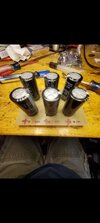

anybody know how much these boxes were back in the day when new? just curious
wow. I just found an old post from a guy on here that said that box was $850 in 1976 or adjusted for inflation $4900 in 2025 money. Good lawd! And guys scoff at $3400 for a two tube z nowadays...
I guess cb amplifiers can never be cheap enough.
I guess cb amplifiers can never be cheap enough.
cb amplifiers can never be cheap enough.
And never will be. At least we aren't seeing the 30-dollar Coca-Cola from Back to the Future three.
73
I do now currently have this amplifier operating, I am not for sure what I did to get it functional I do not know if the tubes were gassy and that's why it was arching in them before or not. I burned them in for like a week with just the heaters on first, then added 1300 Volts to the plate and no arching occurred " I used half the PS like they do the driver " and I turned the amp on every night for a few hours for about a week like this. Then I did add the 10 watt 2 ohm resistor that is like a soft start on the power supply section as my amp didn't previously have one and it appeared like it never did have one. Then I applied all 2700 vdc plate voltage to the 3-500z tubes and no more arching! For now I have the driver bypassed and used Nomads keying circuit and am driving it with a JB 200 modulator off a Tram and seeing around 1000 watts of average swing on a MFJ meter. I had ran the amp for a few evenings and it appears to run very well however last night it started popping the breaker on the back of the unit however right now I am thinking that breaker may just be weak as I hear no other sounds or smells in the amp so far and I reset the breaker and it take off just fine again for awhile, it even trips if I just use my trams power as the driving unit not even using the modulator so I know its not tripping because its being overdriven. So far so good anyways so happy to have gotten somewhere with it ! Thank you very much everyone for your assistance and advice!
Yes I believe so, and not sure whyI just realized looking at the cathode are they running these on series at 10v? I wonder why they chose to do that
The series filament connection lets you use wire half as thick on the cathode choke. Also shrinks the wire size needed to wind the filament secondary on the power transformer.
Just be sure to put a fan of some sort just below the tube sockets. Doesn't have to be big, only needs a breeze not a hurricane. The wire that powered the driver tube's heater can feed a half-wave rectifier feeding into a 1000 uf filter cap. This will power a small 12-Volt DC fan. We drill two holes in the lip of the rail that runs under the chassis from side to side. A small fan only needs two mount holes to be stable. A 24-Volt DC fan running from 12 Volts
Kinda like this:
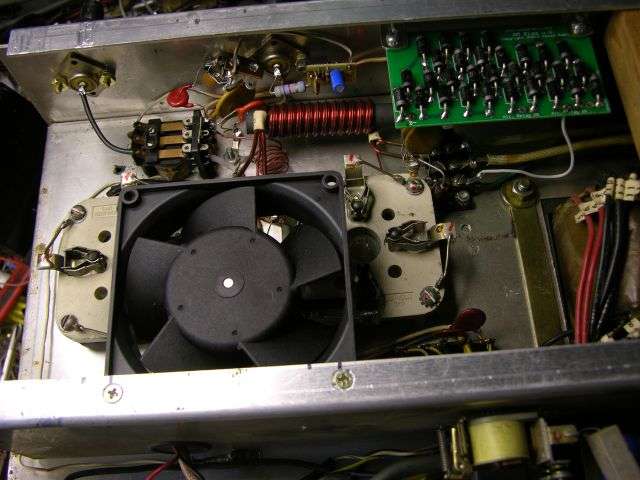
Adding cathode bias with a zener helps keep the heat down, but you'll want to install a tuned-input matching circuit if you do. It's barely visible in this image. I have pics of that, but not on the server I can access from home. I'll track that down next time I get to work.
73
Just be sure to put a fan of some sort just below the tube sockets. Doesn't have to be big, only needs a breeze not a hurricane. The wire that powered the driver tube's heater can feed a half-wave rectifier feeding into a 1000 uf filter cap. This will power a small 12-Volt DC fan. We drill two holes in the lip of the rail that runs under the chassis from side to side. A small fan only needs two mount holes to be stable. A 24-Volt DC fan running from 12 Volts
Kinda like this:
Adding cathode bias with a zener helps keep the heat down, but you'll want to install a tuned-input matching circuit if you do. It's barely visible in this image. I have pics of that, but not on the server I can access from home. I'll track that down next time I get to work.
73
Yes, sir I did add a small AC fan down there in that location already as I have heard and read about the pins solder getting to hot at times. I did not add any bias or any input tune at this time but am very interested in it if it will make this box run better and or more efficient. My input swr is currently 2.0 I didn't think that was bad enough to mess with the tune. Not really sure what the biasing board that you have used does or the purpose of it ? Keeps the 3-500z biased with negative voltage and keeps them under control more and cooler ? How much power loss is noticed? Or is the bias only present on standby unkeyed ? ThanksThe series filament connection lets you use wire half as thick on the cathode choke. Also shrinks the wire size needed to wind the filament secondary on the power transformer.
Just be sure to put a fan of some sort just below the tube sockets. Doesn't have to be big, only needs a breeze not a hurricane. The wire that powered the driver tube's heater can feed a half-wave rectifier feeding into a 1000 uf filter cap. This will power a small 12-Volt DC fan. We drill two holes in the lip of the rail that runs under the chassis from side to side. A small fan only needs two mount holes to be stable. A 24-Volt DC fan running from 12 Volts
Kinda like this:
Adding cathode bias with a zener helps keep the heat down, but you'll want to install a tuned-input matching circuit if you do. It's barely visible in this image. I have pics of that, but not on the server I can access from home. I'll track that down next time I get to work.
73
They were really being thrifty if they were saving a buck on choke wire diameter ... Jeez louise
Last edited:
dxChat